Designing During Nap Time: Real-Life Creative Rhythms
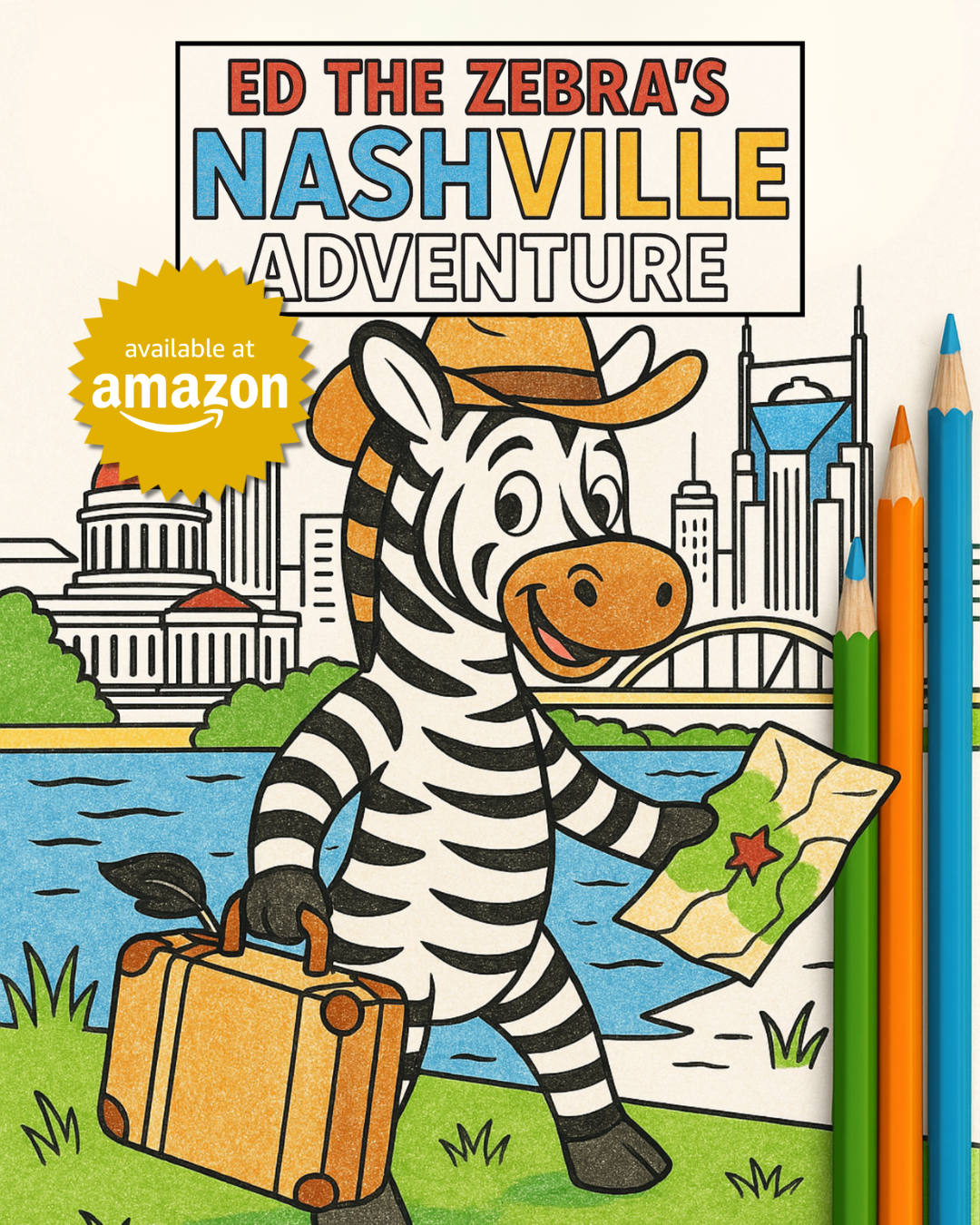
Ed the Zebra’s Nashville Adventure was never just about a zebra.
I created this coloring book during a season when everything felt loud. The news cycle was relentless. Political conversations seemed to leak into every space. Even ordinary interactions felt heavy. I found myself craving something lighter, not as escapism, but as a reminder that not everything has to be urgent, polarizing, or exhausting.
And then something unbelievable happened.
A rambunctious zebra escaped from his farm and ran wild through the streets of Middle Tennessee for eight unforgettable days. Suddenly, the headlines changed. The conversations shifted. Social media, which had been filled with outrage and arguments, was now filled with blurry zebra sightings, memes, speculation, and laughter.
Strangers were united by a striped animal on the loose.
Neighbors texted each other updates. Parents showed their kids the news. Radio hosts joked about him. For a brief moment, the collective tone softened. The conversation transitioned from crime reports and political commentary to curiosity and humor. People who rarely agreed on anything found themselves rooting for the same runaway zebra.
It was unexpected. And it was beautiful.
I kept thinking: What if we just slowed down? What if families had a way to keep the magic of Ed’s adventure going? What if instead of reacting to headlines, we reached for crayons? What if we captured that shared laughter and turned it into something tangible, something that could live at kitchen tables long after the zebra was safely home?
That question became the seed for this book.
Ed the Zebra’s Nashville Adventure became a way to extend that collective exhale. It was a way to preserve the joy of those eight days when our region was united by something playful and absurd. The coloring book format was intentional. Coloring slows people down. It invites focus. It creates shared space. When hands are busy with crayons, conversations naturally become gentler and more present.
This wasn’t about capitalizing on a news story. It was about protecting a feeling and elongating that brief window when laughter replaced division.
I wanted families to sit side by side and color the skyline. I wanted children to ask questions about Nashville landmarks. I wanted neighbors to smile at the memory of the zebra who somehow became everyone’s favorite headline.
In a culture that moves fast and reacts faster, sometimes connection needs something simple to anchor it.
Sometimes, life just needs a runaway zebra.
A Zebra as a Reset Button
There is something disarming about a zebra in boots wandering through Nashville. It’s playful. A little absurd. Entirely harmless. And that’s exactly why it works. Humor softens people. It creates common ground. You don’t have to agree on politics to laugh at a zebra standing outside the Parthenon. You don’t have to share the same worldview to smile at a striped animal exploring Broadway.
The story became a kind of reset button. It gave families a reason to pause at the table together. It gave parents a way to redirect anxious energy into creativity. It gave neighbors something light to talk about instead of something divisive.
Creating in the Margins
This book was designed during nap time. Not in long, uninterrupted creative retreats. Not in perfect silence. But in the small, ordinary windows that motherhood allows. Twenty-five minutes while the house was quiet. A quick sketch before someone woke up. Editing a page with one ear tuned toward the baby monitor.
At first, I thought I needed bigger blocks of time to create something meaningful. What I discovered instead was that rhythm matters more than length. When I committed to steady, consistent work in the margins, the pages began to accumulate. There is something grounding about building something joyful in the middle of ordinary life. It reminded me that creativity does not require ideal conditions. It just requires intention.
Designing for Participation
Because Ed the Zebra’s Nashville Adventure is a coloring book, design was central to the experience. The lines had to be bold enough for small hands. The illustrations needed detail without becoming overwhelming. Each page needed enough open space to invite imagination rather than restrict it.
Coloring is not passive. It requires focus. It slows the pace of the room. It brings people physically close to one another, leaning over the same table, reaching for the same colors, commenting on each other’s choices. Conversation flows more naturally when hands are busy.
I wanted the book to feel spacious and welcoming. Not cluttered. Not rushed. Each Nashville landmark appears as part of a journey, inviting people to move through the city with Ed at their own pace. The design supports that rhythm of slowing down.
From Idea to Amazon
Publishing through Amazon KDP was the practical bridge between idea and reality. I learned quickly that creativity and execution are different disciplines. Formatting trim sizes correctly, calculating spine width, setting proper bleed margins, uploading interior files, ordering proof copies, each step required precision.
There were small corrections along the way. Adjustments to alignment. Tweaks to spacing. Re-uploads and waiting. The process was technical, but it never felt disconnected from the heart behind the project.
The goal was not simply to say I published a book. The goal was to place something tangible into people’s hands that could live on kitchen tables, coffee tables, and classroom desks.
Why This Matters
As someone who works in Connection Ministry, I think constantly about belonging. I think about how people move from awareness to engagement to commitment. I think about how environments shape behavior and how small details influence whether someone leans in or pulls back. Belonging does not only happen inside church buildings. It happens at dinner tables. On sidewalks. In car lines. It happens when people feel safe enough to laugh together.
Ed the Zebra’s Nashville Adventure is a small offering toward that kind of belonging. It is a reminder that connection does not always require a structured program. Sometimes it starts with something simple, playful, and shared.
Creative Work as Gentle Resistance
In a culture that monetizes outrage and rewards constant urgency, choosing to create something light is a quiet act of resistance. Choosing to sit with a child and color instead of scrolling through headlines is a countercultural decision. Choosing to laugh with a neighbor instead of debating them builds a different kind of community.
This book was created in the margins of motherhood, but it carries a larger hope that families would slow down, that conversations would soften, and that joy would interrupt anxiety.
Sometimes connection begins with something funny, and this season, a zebra in boots is exactly what we needed.
Get your own copy of Ed the Zebra’s Nashville Adventure!
This article may not be republished without written permission from Stephanie F. Prince.